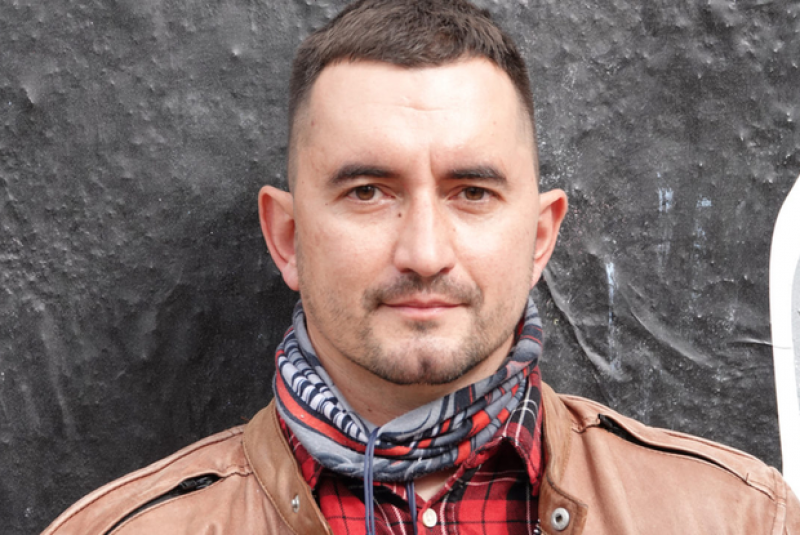
Political prisoner Scjapan Latipau attempts suicide for the third time

Dragan P.
March 29, 2026
7:59 PM
Original Source

Stepan Latipov

Human rights defenders have learned that in July 2025, political prisoner and resident of the “Square of Changes,” Scjapan Latipau, was transferred from Mogilev Prison No. 4 to Penal Colony No. 22, known as the “Wolf Holes.” There, he was immediately placed in a punishment isolation cell (SHIZO), and then transferred to prison-type facilities (PKT). While there, Scjapan cut his veins, which were later stitched up.

Before continuing, let us clarify the following terms for better understanding:

  • “Square of Changes” – This is a nickname for a courtyard between residential buildings in Minsk, which became one of the symbols of resistance during the 2020 protests. Scjapan lived there and became known for defending the area from police attempting to remove anti-government graffiti.
  • Prison (in Mogilev): A classic building with cells where prisoners are confined most of the time.
  • Penal Colony (No. 22 “Wolf Holes”): A camp where prisoners usually live in barracks and work. “Wolf Holes” is a notorious colony, known for being isolated in forests and intended for those the regime seeks to break the most.
  • SHIZO (Punishment Isolation): The strictest form of solitary confinement. Cells are small and cold, without bedding (beds are folded into the wall during the day), and prisoners are not allowed to receive parcels, letters, or visits. It is a space of total isolation and physical exhaustion.
  • PKT (Prison-Type Facilities): Slightly less strict than SHIZO but still extremely harsh. The prisoner is confined to a small cell instead of shared barracks, with very limited movement and rights.

In PKT, the political prisoner was held in poor conditions: there was not even a power outlet in the cell, and boiling water or hot water was provided only twice a day. Around September 2025, Scjapan was transferred back to prison. He reportedly said that he sees no meaning in life and would not endure another sentence under prison conditions.

Let us recall that arborist Scjapan Latipau was detained in September 2020 near his home at the “Square of Changes.” On August 16, 2021, he was sentenced for participation in protest actions, “resisting police officers,” and “fraud on an especially large scale” to eight years and six months in a high-security regime. The political prisoner did not plead guilty to any of the charges in court.

His first suicide attempt occurred in the summer of 2021 directly in the courtroom, when he stabbed himself in the neck with a pen. He underwent surgery in hospital and was then transferred to Pre-trial Detention Center No. 1.

In the colony, Scjapan was under constant pressure from the prison administration—he was repeatedly placed in punishment isolation (SHIZO) and prison-type facilities (PKT). In protest against this pressure, he swallowed a razor blade and again cut his veins. After this incident, in autumn 2022, his prison regime was changed, and he was transferred for two years to Mogilev Prison No. 4.
Explanations

PKT (Russian: pomeshcheniye kamernogo tipa / помещение камерного типа) is an acronym used in the Belarusian and Russian prison systems to designate cell-type premises.

If a penal colony is imagined as a kind of "camp" where prisoners live in shared barracks and move relatively freely within a fenced area during the day, PKT is a prison within a prison. It is a stricter level of punishment intended for "persistent violators" of prison discipline.

Here is a precise breakdown of what confinement in PKT means for a prisoner:

1. Transition from Barracks to a Locked Cell

The most significant difference lies in the living conditions. In the standard regime of a penal colony, prisoners sleep in large dormitories (barracks) housing 50 to 100 people. When a prisoner is transferred to PKT, they are locked in a small, secured cell, which they share with only a few other prisoners (usually 2–4) or occupy alone.

2. Severe Material Restrictions

Staying in PKT severely limits the rights a prisoner normally enjoys in the standard section of the colony:

  • Spending Limits: The amount of money a prisoner is allowed to spend on food and essential items is reduced to a bare minimum (significantly lower than in the standard regime).
  • Parcels and Visits: The number of allowed parcels from home and family visits is cut to the absolute minimum (often just one parcel and one short visit every six months).
  • Personal Belongings: Prisoners are permitted to keep only a very limited number of personal items with them.

3. Daily Routine and Labor

Prisoners in PKT are still required to work, but this labor takes place in separate, isolated workspaces or within the cell itself. Movement is restricted to 30–60 minutes of exercise per day in a small, walled-in yard, which is essentially just a "cell without a roof."

4. Difference Between PKT and SHIZO

It is important to distinguish between the two to understand the levels of severity:

  • SHIZO (Punishment Insulator): The harshest form (solitary confinement, extreme cold, bed locked against the wall during the day, limited to 15-day stints).
  • PKT (Cell-type Premises): A long-term punishment. A prisoner can be sentenced to PKT for up to 6 months. Here, they have bedding, the bed is not locked during the day, and they retain the right to read books and write letters, though they remain completely isolated from the general prison population.

5. PKT as a Tool of Pressure

In the case of political prisoners like Stsyapan Latypau, PKT is used as a tool for psychological breaking. Long-term isolation in a cramped space, restricted contact with family, and constant surveillance cause severe psychological distress.

Additional pressures, such as those mentioned earlier (lack of electrical outlets, boiling water provided only twice a day), are methods used by prison administrations to make life in PKT even more unbearable than what is officially prescribed by law.

A camp where prisoners usually live in barracks and work. “Wolf Holes” is a notorious colony, known for being isolated in forests and intended for those the regime seeks to break the most.

SHIZO (shtrafnoy izolyator) is one level lower – it is the harshest form of punishment that exists within Belarusian and Russian prisons. If PKT is a "strict prison within a colony," SHIZO is a "concrete hole designed to completely break a person."

Here is a detailed description of what SHIZO actually means for a prisoner:

1. Total Deprivation of Material Supplies A prisoner is allowed to bring nothing into SHIZO. Their personal clothes are taken away and they are given a special, thin prison uniform. The following are prohibited:

  • Personal hygiene items (except for soap and a toothbrush at specific times).
  • Books, paper, pencils.
  • Food other than prison rations (all treats or tea are forbidden).
  • Letters and visits (total information blockade).

2. Torture through Sleep Deprivation and Cold This is the cruelest part of SHIZO. The cells are usually in basement areas, damp, and extremely cold.

  • The Bed (Bunk): In the morning (usually at 5 or 6 AM), the bed is raised and locked against the wall. The prisoner is not allowed to lie on it or even sit on it until evening.
  • Sitting: Usually, there is only a narrow wooden or metal stud (without a backrest) fixed to the floor in the cell.
  • Prohibition of Lying Down: If a prisoner lies on the floor, the guards punish them. A person is forced to stand or sit on a hard surface for 16 hours a day.

3. Hygiene and Space The cell is only a few square meters in size. The sanitary facility is often just a hole in the floor ("squat toilet") with no privacy. The sink provides only cold water. The light is dim, and the air is stale because the windows are covered with dense metal meshes.

4. The Purpose of SHIZO Officially, it is used to punish violations (e.g., if a prisoner has an unbuttoned button). In the case of political prisoners, SHIZO is used as:

  • Physical Torture: Due to the cold and lack of sleep, the body weakens rapidly.
  • Psychological Breakdown: Without human contact and without anything to read or write, a person in solitary confinement quickly loses their sense of time and space.

This is a nickname for a courtyard between residential buildings in Minsk, which became one of the symbols of resistance during the 2020 protests. Scjapan lived there and became known for defending the area from police attempting to remove anti-government graffiti.

Share Article
Last updated: Mar 29, 2026 8:15 PM