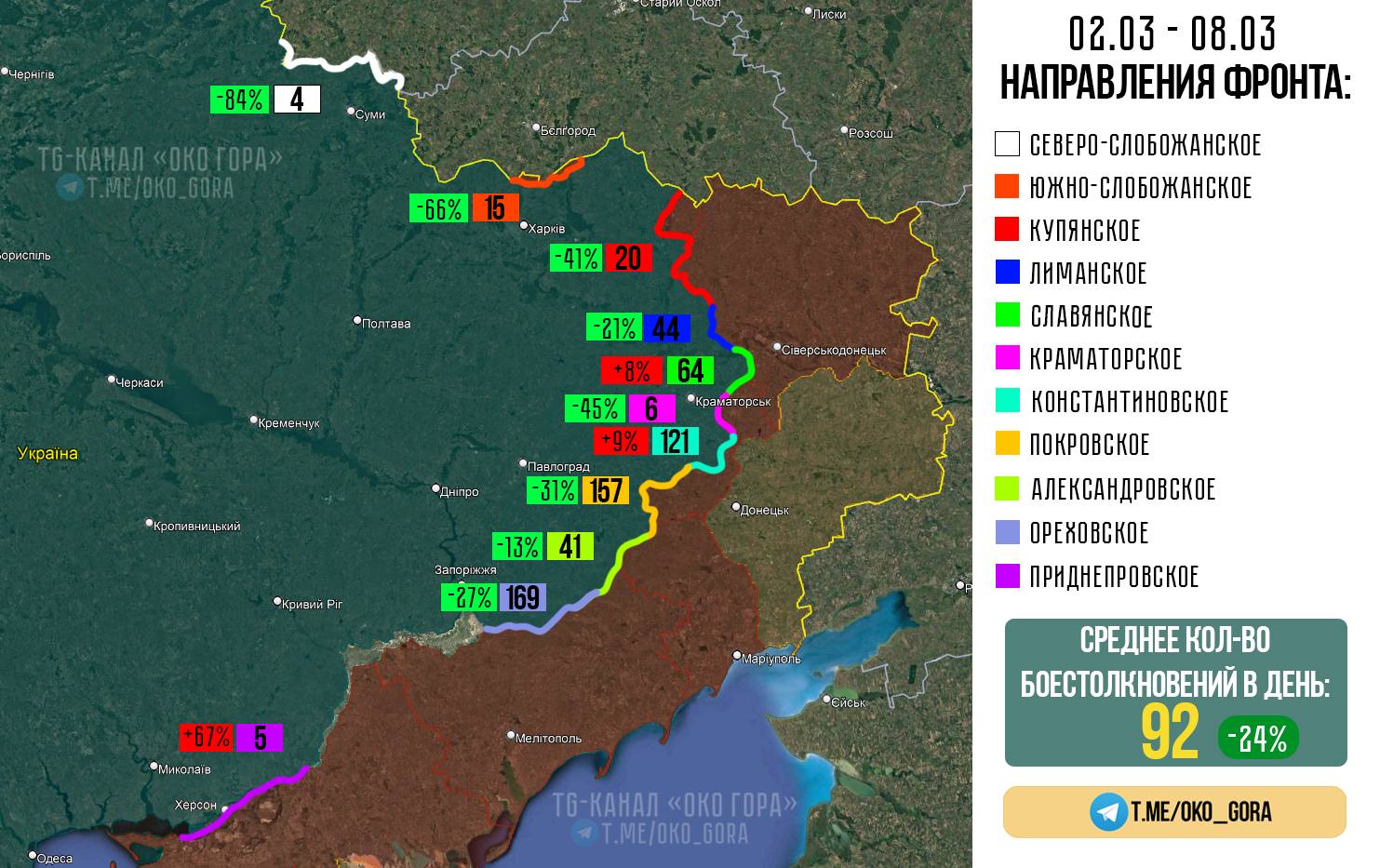
In recent months, the Ukrainian army has been visibly changing the way it uses drones on the battlefield. Instead of focusing primarily on destroying Russian assault groups right on the front line, the emphasis is increasingly shifting to the Russian rear in the depth of the battlefield — roads, logistics, communications, air defence, drone crews’ deployment areas, depots and repair assets.
The essence of this new logic is simple: it is not enough to inflict heavy losses on the enemy at the front if it can still bring in new men, ammunition, fuel and drones. As long as Russian units can move with relative safety 10, 20 or 40 kilometres behind the front, they retain the ability to renew attacks, even at enormous cost.
This is precisely where Ukraine is now trying to force a breakthrough.
The previous approach often produced striking tactical results: Russian infantry suffered heavy losses, certain access zones were kept under constant fire, and movement on the front line became increasingly dangerous. Yet this alone was not enough to stop the Russian advance. Even when losses were severe, Russian forces still managed to push forward, build up manpower in forward areas and continue attacking with the support of their own drones and logistics.
At the same time, Ukraine was also feeling the effects of Russian pressure on the depth of the front. Drones were increasingly threatening supply routes, and some cities near the line of combat were put in a position where they were almost cut off, even though they were not formally encircled. If a road exists only on a map but can no longer be used safely, the defence of that sector becomes extremely fragile.
Ukraine’s new strategy is based on the idea that wars are not decided only in the trenches, but behind them as well. Control of depth means control over the enemy’s movement: its transport, fuel and ammunition deliveries, unit rotations, reconnaissance, communications and drone crews. In other words, the goal is no longer only to destroy those who have already reached the front line, but to make sure they do not reach it at all.
That is why Ukrainian drones are now increasingly targeting not infantry as such, but the system that keeps that infantry moving. The targets are logistics hubs, supply vehicles, workshops and repair teams, positions of Russian drone operators, communication assets, artillery and mortars, as well as air defence. What is especially important is that strikes are increasingly hitting roads and movement zones tens of kilometres behind the line of contact.
This changes the very character of combat. If routes to the front are constantly under threat, Russian units arrive at positions more slowly, struggle more to bring in ammunition and fuel, rotate personnel more slowly, and attacks lose their rhythm. In practice, this means that even without major shifts in the front line, the enemy can lose the capacity for sustained assaults.
Available indicators suggest that the first effects of this approach are already visible in some sectors, where the tempo of Russian attacks has slowed. This does not amount to a complete halt of the front, but it is a change that gives the defence valuable time: to fortify positions, reorganise logistics and prepare countermeasures.
An important part of this shift is technological adaptation. Ukraine is increasingly using longer-range drones, including aircraft-type systems, as well as platforms capable of operating at greater distance with less vulnerability to electronic jamming. In addition, the use of drones on non-standard frequencies is expanding, making enemy electronic warfare less effective until it adapts. Systems that provide stable control at longer distances, as well as fibre-optic drones that are resistant to conventional jamming, are also playing a particular role.
Another important element of Ukraine’s new logic is the systematic targeting of Russian air defence. In modern warfare, no serious operation can be built over the long term without suppressing or destroying the enemy’s air-defence network. Ukraine is increasingly trying to do exactly that: opening corridors for its own strikes, destroying radars and launchers, and thereby creating conditions for even deeper and freer action by its unmanned systems.
The shift applies not only to defence, but also to attack. Under the new approach, before attempting a breakthrough, drones first “prepare” the depth of the battlefield: Russian drones, communications, logistics and command functions are neutralised in a narrow sector, and only then do mobile groups and forces tasked with consolidating captured positions move in. It is an attempt to adapt the classic idea of battlefield shaping to a war in which aviation cannot operate freely, and swarms of drones are partly taking over that role.
Of course, the question of how long this effect can last remains open. The Russian army has previously managed, over time, to adapt to new threats, although often with significant delay and at high cost. Much will therefore depend on whether Ukraine can quickly scale up this practice, maintain production tempo, secure enough trained crews, and continue receiving financial and technical support from its partners.
But the direction of change is clear. Ukraine is trying to pull drone warfare out of the trenches and extend it across the entire space behind the front. The goal is no longer simply to stop the enemy bloodily on the first line, but to deprive it of freedom of movement, break its logistics and disrupt the entire system by which forces are brought into battle.
If this approach really takes hold on a full scale, the consequences could be far greater than just another tactical success: it could change the very rhythm of the war.