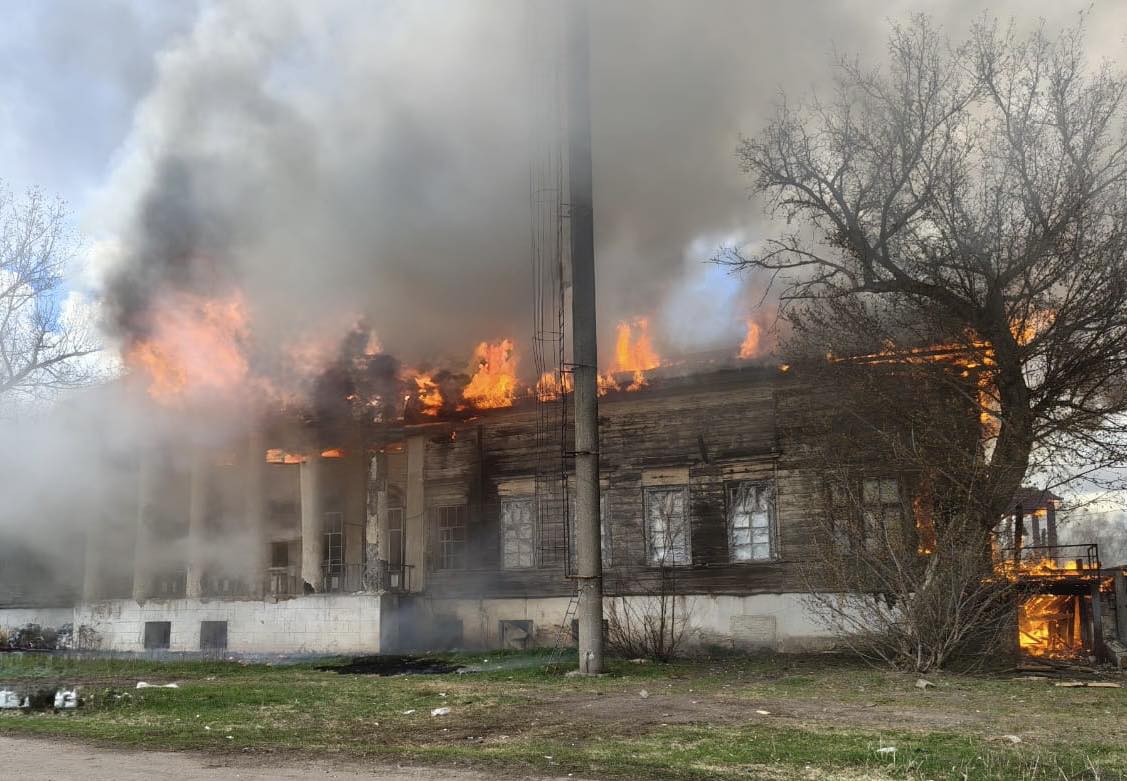
Velykyi Burluk, Kharkiv region – A Russian military strike on April 7, 2026, resulted in the complete destruction of the historic Donets-Zakharzhevsky estate, a 19th-century architectural monument that had survived some of the darkest periods of European history but did not withstand modern Russian aggression against Ukraine.
The destruction was reported by the head of the Kupiansk District Military Administration, Andrii Kanashevych, who stated that the estate was completely ruined following shelling of the settlement of Velykyi Burluk. According to him, a fire broke out on the grounds of the historic complex after a direct hit, ultimately destroying the building.
“An architectural monument of the 19th century, the Donets-Zakharzhevsky estate, whose construction was completed around 1835, which survived the turbulent 20th century, two terrible world wars, and the Soviet era with its hatred toward national memory, was destroyed on April 7, 2026,” Kanashevych said.
The estate, located in the settlement of Velykyi Burluk in the Kharkiv region, was one of the important architectural heritage sites of local significance. It was officially included in the register of cultural monuments in 1980 and held protected status. The building was constructed in the classical style and represented an important example of noble architecture from the first half of the 19th century.
Historically, the estate was associated with a branch of the Sloboda Cossack officer family Donets-Zakharzhevsky, specifically the Zadonsky lineage. Although many elements of the estate complex—including outbuildings and the park—were lost over time, the main building remained preserved until its destruction in the recent attack.
Beyond its architectural value, the estate was also known for its alleged connection to one of the most mysterious discoveries in Eastern European history. According to one version, wooden tablets with inscriptions—linked by some researchers to the so-called “Veles Book,” a controversial historical document believed by some to be part of ancient Slavic heritage—were reportedly found there.
The destruction of the Donets-Zakharzhevsky estate is both symbolic and tragic, illustrating the broader scale of cultural heritage destruction during Russia’s invasion of Ukraine. A structure that survived both world wars, political repression, and ideological attempts to erase national memory during the Soviet period ultimately did not survive the realities of modern warfare.
The strike on Velykyi Burluk was not an isolated incident. On the same day, Russian forces carried out multiple attacks across different regions of Ukraine. During the night of April 7, strike drones targeted warehouses of a food company in Pavlohrad in the Dnipropetrovsk region, marking the third attack on the same enterprise since the beginning of the year.
Later that morning, a civilian bus in Nikopol, also in the Dnipropetrovsk region, was struck by a drone during rush hour as people were commuting to work. Four people were killed in the attack, and sixteen others sustained injuries of varying severity.
Additional strikes targeted civilian and administrative buildings. In the city of Pryluky in the Chernihiv region, a municipal administration building located at a busy central intersection was hit. A drone also struck the building of the state tax inspection in the border town of Novhorod-Siverskyi.
These attacks highlight the continued pattern of Russian strikes on both military and civilian targets, often resulting in civilian casualties and the destruction of critical infrastructure and cultural heritage.
The destruction of the Donets-Zakharzhevsky estate therefore represents not only the loss of an architectural monument but also a symbolic blow to Ukraine’s historical memory and cultural identity. In the context of a war that has lasted for years, such events further underscore the масштаб of damage inflicted not only on people but also on the country’s historical heritage.