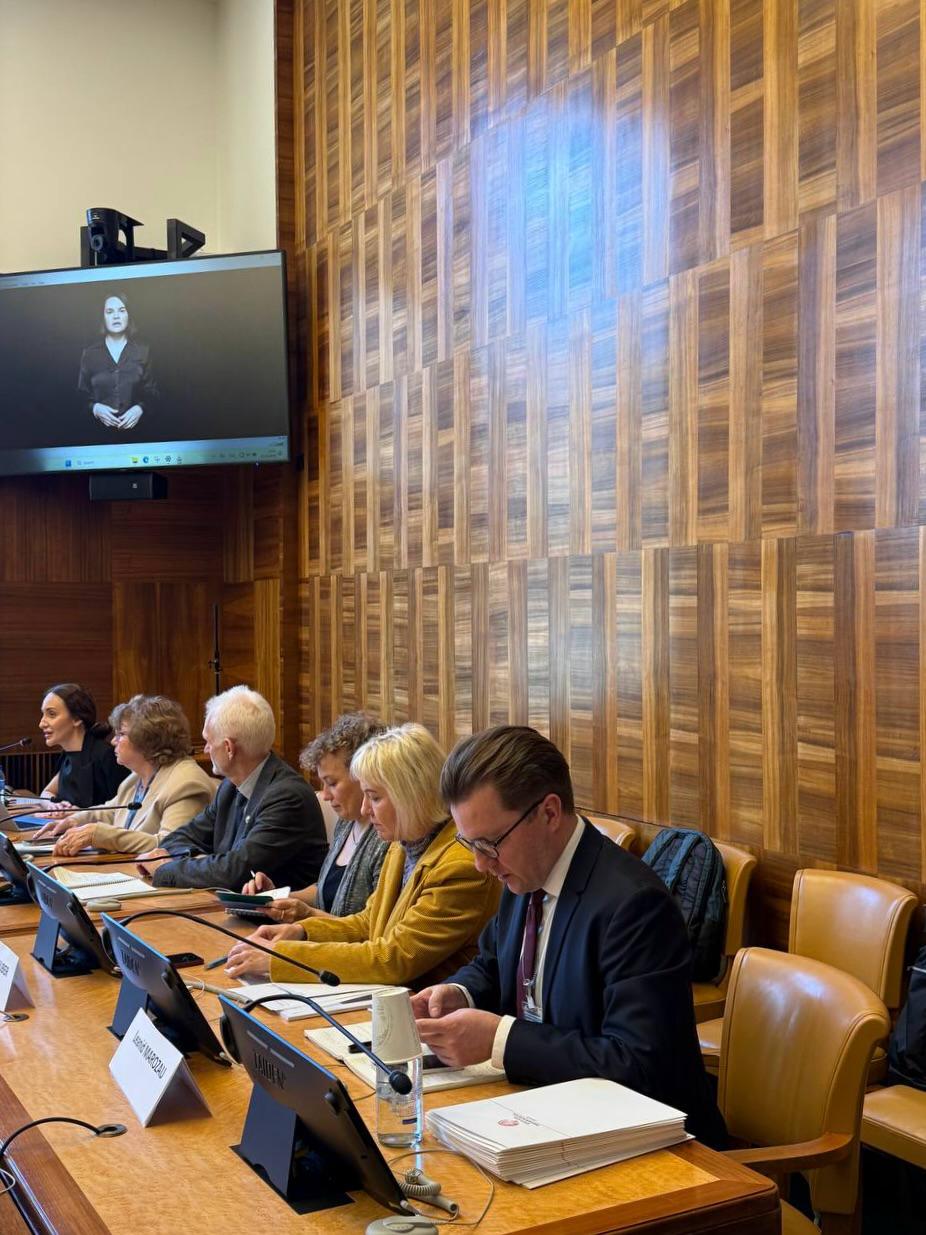
GENEVA — In the margins of the 61st session of the UN Human Rights Council, an important side event titled "Human Rights in Belarus" was held on March 12 in Geneva. The discussion focused on the dramatic deterioration of the situation for political prisoners in Belarusian prisons and the issue of international accountability for the regime in Minsk.
The event brought together key voices from the Belarusian opposition and international legal experts at a time when repression in the country shows no signs of waning.
Nobel Laureate Bialiatski as a Symbol of Resistance
Special weight was given to the event by the presence of Ales Bialiatski, Nobel Peace Prize laureate and chairman of the Viasna Human Rights Center. Bialiatski, who was recently released from prison, served as a living reminder to the international community of the high price Belarusians pay for their struggle for freedom and fundamental rights.
In addition to Bialiatski, the discussion featured:
- Leonid Morozov, legal advisor to the leader of democratic Belarus, Sviatlana Tsikhanouskaya;
- Andrea Huber, head of the International Accountability Platform for Belarus (IAPB);
- Karina Moskalenko, independent UN expert on Belarus.
Tsikhanouskaya: "Political Prisoners Must Not Be a Currency for Trade"
On the same day, Sviatlana Tsikhanouskaya addressed the participants of the UN Human Rights Council. In her speech, she was steadfast: she called for the release of all political prisoners without exception, continued international pressure on the regime of Alexander Lukashenko, and the establishment of mechanisms for the legal accountability of those carrying out the repression.
Legal advisor Leonid Morozov sharply condemned the regime's attempts to portray the release of prisoners as a humanitarian gesture.
"When the regime demands gratitude for releasing people it illegally threw behind bars itself, it is like asking for applause for a kidnapper because he returned the hostages," Morozov said. "People should never be objects of trade or diplomatic currency. The only true humanitarian step is the release of all political prisoners alongside an immediate end to the repression."
International Accountability and the Future
Andrea Huber and Karina Moskalenko emphasized the importance of gathering evidence of human rights violations to be used in future legal proceedings before international tribunals. The panelists agreed that without external pressure and clear demands for justice, the regime will not stop its systematic suppression of civil society.
The organizers of the event, which included the Institute for Human Rights led by Emin Huseynov, stressed that Belarus must not disappear from the radar of the global public, despite the numerous other crises occurring around the world.