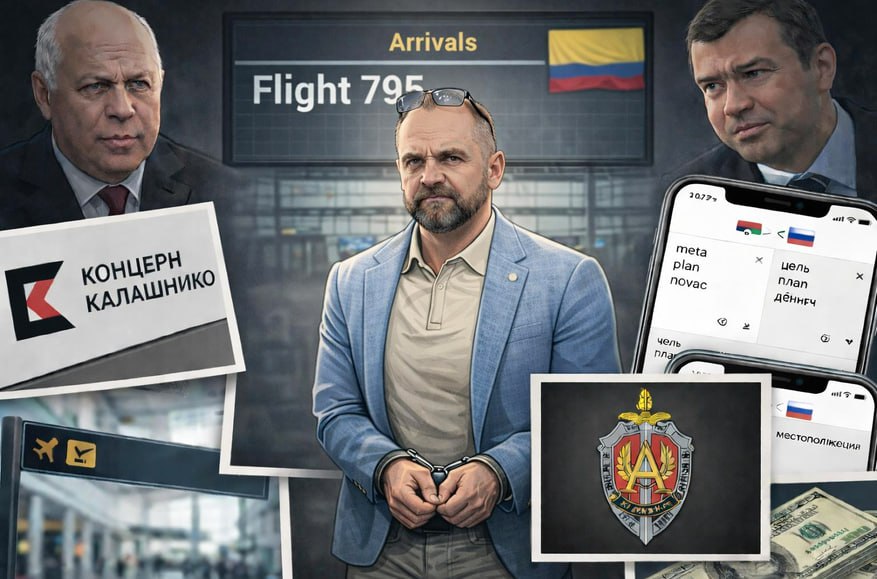
A new investigation by the Russian investigative outlet The Insider, an independent media organisation run by Russian journalists in exile, has offered the most detailed look yet at Centre 795 — a new, highly secretive Russian structure linked to sabotage, kidnappings and political assassinations abroad. At the heart of the story is one of its operatives who, according to the outlet, was brought down by an error that seems almost comic: he communicated with his Serbian “associate” through Google Translate.
According to the investigation, Russian operative Denis Alimov allegedly used a network of people from the Balkans for certain assignments in Europe. His key associate is said to have been Darko Đurović, a Serb living in the United States whom the US authorities in this case describe as an alleged hired killer. Among Alimov’s contacts from the Serbian-speaking world, the investigation also names Davor Savičić and Dejan Berić, both known for their links to recruiting fighters for the Russian side in the war against Ukraine.
The problem was that Alimov and Đurović did not share a common language for secure operational communication. Instead of using a safer solution, they turned to Google Translate. As a result, The Insider says, messages they sent through encrypted apps ended up in readable form on the servers of an American technology company, which investigators were later able to access under a court order. Those translation traces, according to the same source, became one of the key elements in the case against Alimov, who is now in Colombia awaiting extradition to the United States.
Behind that almost farcical episode, however, lies a much more serious story. The Insider says Alimov was part of an entirely new and exceptionally closed Russian unit known as Centre 795, or military unit 75127. According to those claims, the structure was set up after the start of the full-scale invasion of Ukraine, when the Russian services needed new capabilities for sabotage, kidnappings and killings abroad.
Unlike operational networks that had already been compromised, Centre 795 was allegedly conceived as a “clean”, fully autonomous alternative — a kind of army within the army, directly tied to the top of the General Staff. The investigation says its ranks were drawn not only from military intelligence, but also from personnel from the FSB’s most elite counterterrorism unit, known as Alpha. The centre is allegedly headed by Denis Fisenko, a former member of that unit.
Particularly striking is the claim that, according to the published data, the centre was based on territory linked to Kalashnikov and Rostec. The project’s main patrons are said to have included Sergei Chemezov, a long-time Putin ally and head of the state conglomerate Rostec, and Andrei Bokarev, a billionaire close to the authorities and to businesses tied to the defence industry. In that sense, the story of Centre 795 is not just the story of a secret unit, but also of the overlap between the special services, the state arms industry and private capital.
As described in the investigation, Centre 795 appears to be a hybrid between a classic state service for political assassinations and something that, in its logic, resembles an institutionalised version of Wagner. It allegedly has both personnel for assassinations and kidnappings and units for combat operations in Ukraine. The report also mentions people linked to older networks previously associated with killings abroad, suggesting that this may not be an entirely new beginning so much as a reorganisation of existing cadres under a new roof.
The Alimov case offers a more concrete glimpse into how the centre operates. According to US prosecutors and documents cited by the investigation, one of the targets was linked to the family of Akhmed Zakayev, the Chechen émigré living in the United Kingdom. Alimov allegedly offered Darko Đurović about $1.5 million for each successfully “deported” target, while for a third person the sum mentioned was as high as $10 million. If those allegations are accurate, they say a great deal about how important those targets were considered to be.
If Alimov one day ends up in an American prison, it is not inconceivable that he could become the subject of some future prisoner swap for political detainees, along the lines of the arrangement through which Moscow earlier secured the return of FSB killer Vadim Krasikov. That, however, is unlikely to apply to Đurović: the Kremlin, as a rule, protects its own professional operatives, not foreign intermediaries and assistants.
The Alimov case, however, is probably only one part of a broader picture. The investigation suggests that Centre 795 caused tensions inside the Russian security apparatus from the outset, especially because it was taking over people and missions from older structures. Those rivalries, by all appearances, made it easier for information about the centre to leak into the public domain and reach investigators.
But the most important point is this: Centre 795 has been exposed, yet it is not harmless. If the published claims are correct, Russia was building a new secret service for kidnappings and murders abroad in parallel with the war in Ukraine — and such a network remains dangerous even once it is no longer fully invisible.