
The case of Svetlana Igorevna Savelyeva, a 40-year-old translator from the Irkutsk region, has recently emerged as one of the most striking symbols of politically motivated trials in Russia. Her story encapsulates several elements that human rights organizations identify as hallmarks of the Russian state’s repressive apparatus: treason charges, "carousel" administrative arrests, allegations of torture, closed-door proceedings, and an exceptionally harsh sentence.
On April 1, 2026, Savelyeva was sentenced to 15 years in a general-regime penal colony for an alleged attempt to commit treason. According to investigators, she sought to cross the front line in Russia’s Kursk region to join Ukrainian forces. Savelyeva, however, insists she only wanted to reach the man she loved—a Ukrainian soldier with whom she had maintained a long-distance relationship for over two years.
Her story is now far more than an individual tragedy; it serves as a stark illustration of how the Russian judicial system leverages wartime conditions to expand repression against its own citizens.
From a Translation Career to a Criminal Trial
Before the invasion of Ukraine, Svetlana Savelyeva’s life was relatively ordinary. A gifted polyglot, she worked as a translator, localizing computer games and translating pharmaceutical documentation. In addition to English, she spoke Ukrainian—a reflection of her family roots.
Following the launch of Russia’s full-scale invasion in February 2022, Savelyeva and her mother viewed the war as a tragedy, standing in quiet opposition to the Kremlin’s policies. During this period, Svetlana met Oleksandr, a Ukrainian soldier, through an online video chat. What began as a chance meeting grew into a serious romantic partnership.
The couple sought to build a life together, but a Russian passport and the ongoing conflict made a shared future nearly impossible. They attempted to find legal routes through third countries—Moldova, Belarus, Armenia, Kazakhstan, and Turkey—but to no avail. When Ukrainian forces entered parts of the Kursk region, Svetlana took a desperate and risky step: she attempted to reach Ukrainian-controlled territory through the combat zone.
Detention and the “Wheel of Arrests”
Savelyeva was detained in the Kursk region on October 16, 2024. The exact circumstances of her initial capture remain murky. After five days in limbo, she appeared before the Leninsky District Court in Kursk on October 21, charged with "disobeying lawful police orders."
The official version claimed she was found intoxicated in public, appearing "unkempt" and speaking incoherently, and had refused a medical examination. Despite her denials, she was sentenced to ten days of administrative detention.
Upon her release, she was immediately re-arrested on identical charges. This practice, known in Russia as the "wheel of arrests" (or "carousel arrests"), involves repeated administrative filings to keep a person in custody without a formal criminal case while security services build more serious accusations. In Savelyeva’s case, this cycle lasted approximately two months.
Allegations of Torture and Coerced Confessions
According to testimony from her mother and former cellmates, Svetlana was subjected to systematic violence during this period. Reports cite the use of electric shocks, beatings, suffocation, forced stripping, and threats of murder and sexual violence.
When her mother was finally permitted to see her, she described Svetlana as emaciated, prematurely graying, and physically broken. Svetlana reportedly whispered details of her torture during an FSB transport, describing the methods used to extract information during interrogations.
These allegations were later included in a report by Mariana Katzarova, the UN Special Rapporteur on human rights in Russia, who highlighted the case as a textbook example of arbitrary detention and torture. Despite the gravity of these claims, no proceedings have been initiated against the officials involved.
The Treason Charge
On December 16, 2024, immediately following her release from the administrative detention center, Savelyeva was arrested on criminal charges. Prosecutors accused her of attempted treason under Article 275 of the Russian Criminal Code—specifically, an attempt to "defect to the enemy."
The prosecution’s evidence included photographs of railway stations, communication with Oleksandr, and financial transactions via a Kazakh banking app. Investigators even claimed she had undergone military training in Kazakhstan.
Her family and Oleksandr dismissed these claims as absurd. The Kazakh app was used simply because sanctions made direct transfers to Russian accounts impossible; Oleksandr was sending her money for basic living expenses. He has repeatedly emphasized that his support was purely personal, not a means of financing military activity.
A Closed Trial and a Harsh Verdict
The trial took place behind closed doors at the Kursk Regional Court. The lack of public access further fueled doubts regarding the transparency and fairness of the process.
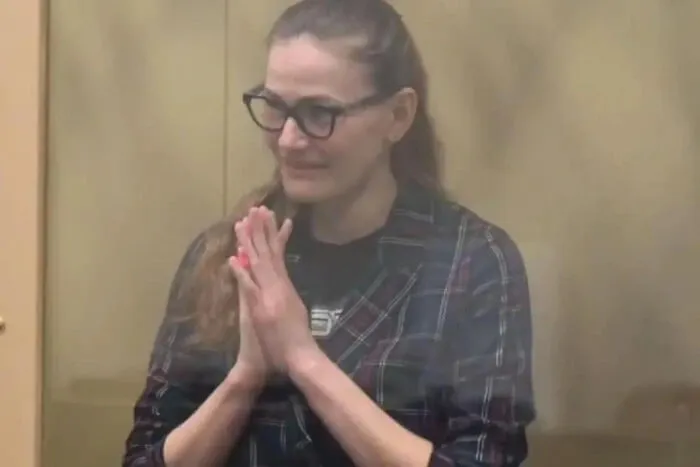
The verdict, delivered on April 1, 2026, was severe: 15 years in a general-regime penal colony. Currently held in SIZO-1 in the Kursk region, Savelyeva is awaiting her appeal. Activists report that she is frequently shackled during court appearances. Her health is deteriorating; she suffers from heart and musculoskeletal issues, and the prolonged use of restraints has reportedly caused permanent numbness in her fingers.
Love as a Political Crime
At the heart of this case lies a conflict of motive. The state argues Savelyeva intended to join the Ukrainian military; she and her loved ones maintain she was simply trying to reach her partner.
The organization Memorial stated there is no convincing evidence of her intent to participate in combat. In their view, her actions were motivated by love and the desire for a shared life. Even if she had intended to join the Ukrainian side, legal experts note that the legitimacy of such a prosecution remains questionable within the context of a war defined internationally as Russian aggression.
Recognition as a Political Prisoner
The independent project "Support for Political Prisoners. Memorial" has officially recognized Svetlana Savelyeva as a political prisoner. The organization argues that her prosecution is intended to intimidate anti-war voices.
Her conviction is part of a broader crackdown: according to the legal project "First Department," hundreds have faced treason or espionage charges since the war began. In the first half of 2025 alone, 244 such verdicts were issued—the highest number in modern Russian history.
A Symbol of the Era
Svetlana Savelyeva’s story is a tragedy of an individual caught between geopolitics and state repression. While the Russian state labels her a traitor, her supporters see a victim of a system that criminalizes personal relationships and anti-war sentiment.
Ultimately, a translator with no military background was sentenced to 15 years in prison for a journey intended to reunite her with the person she loved. In modern Russia, that is now enough to constitute treason.

 style="height: 190px; object-fit: cover;">
 style="height: 190px; object-fit: cover;">
 style="height: 190px; object-fit: cover;">